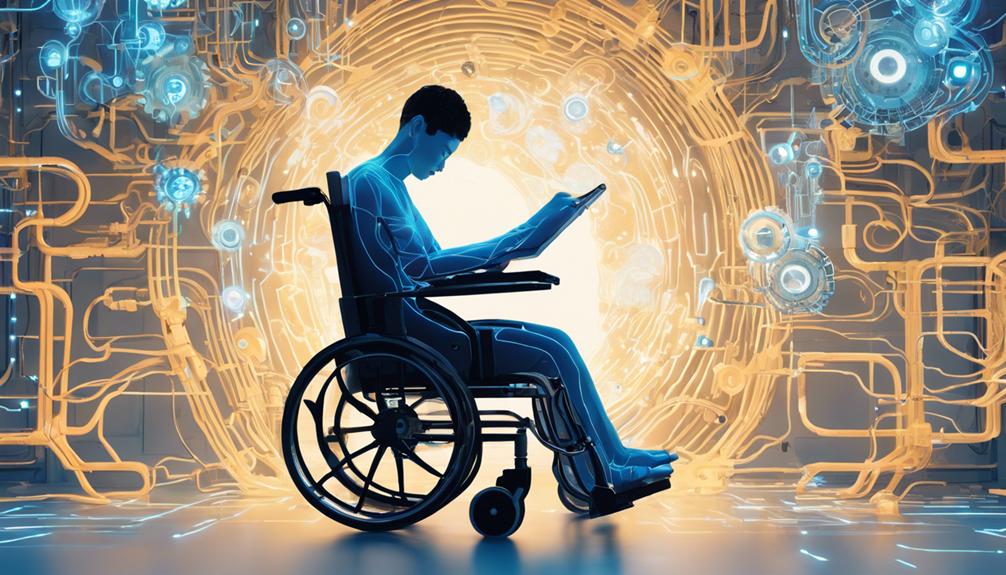
We're witnessing a revolution in accessibility, where technology is bridging the gap between ability and disability, empowering individuals to overcome barriers and harness their full potential. AI, VR, and IoT innovations are amplifying accessibility, while smart homes and transportation systems are increasing independence. Wearable devices, inclusive education, and employment opportunities are also leveling the playing field. As we explore the intersection of technology and disability, we're discovering innovative solutions that promote equality and inclusivity. And there's still so much more to explore – the future of accessibility is looking brighter than ever, and we're just getting started.
Artificial Intelligence for Accessibility
As we navigate the complexities of disability, we're increasingly turning to artificial intelligence to amplify accessibility, and the results are nothing short of remarkable. The potential for AI to revolutionize the lives of individuals with disabilities is vast, and we're just starting to scratch the surface. For instance, AI-powered chatbots are being used to provide personalized assistance to people with disabilities, helping them navigate everyday tasks with greater ease. These virtual assistants can be integrated into smart homes, allowing individuals to control their living environments with simple voice commands.
Moreover, AI-driven tools are being developed to help people with disabilities communicate more effectively. For example, AI-powered speech-to-text systems are enabling individuals with speech or language disorders to express themselves more confidently. Similarly, AI-driven image recognition systems are being used to help visually impaired individuals navigate their surroundings with greater independence. We're also seeing AI being used to develop more personalized and effective rehabilitation programs, tailored to the unique needs of each individual. As we continue to explore the possibilities of AI in accessibility, we're excited to see the transformative impact it will have on the lives of individuals with disabilities.
Virtual Reality in Rehabilitation
As we explore the intersection of technology and disability, we're excited to examine how virtual reality is revolutionizing rehabilitation. We're going to look at how immersive VR experiences can be used for pain management, providing new hope for individuals struggling with chronic pain. We'll also discuss how VR can be used to create personalized therapy plans, tailored to each individual's unique needs and goals.
Immersive Pain Management
We're harnessing the therapeutic potential of immersive technologies to revolutionize pain management, leveraging virtual reality to reduce discomfort and enhance rehabilitation outcomes. By creating personalized, controlled environments, we can distract patients from pain, reducing their discomfort and anxiety. In virtual reality, patients can engage in relaxing experiences, such as guided meditation or calming landscapes, to alleviate pain perception.
Additionally, immersive pain management can facilitate exposure therapy, allowing patients to confront and overcome fears or anxieties associated with their condition. For instance, amputees can practice walking or running in a virtual environment, building confidence and reducing phantom limb pain. Virtual reality can also enhance physical therapy, enabling patients to perform exercises in a more engaging and enjoyable way. As we continue to explore the possibilities of immersive pain management, we're optimistic about its potential to transform the rehabilitation experience and improve patient outcomes.
Personalized Therapy Plans
By harnessing the power of virtual reality, we're creating customized rehabilitation plans that cater to individual needs, allowing therapists to tailor exercises and activities that accelerate recovery and improve patient outcomes. This personalized approach enables us to address the unique challenges and goals of each patient, making the rehabilitation process more effective and efficient.
With virtual reality, we can:
- Create immersive and engaging experiences that motivate patients to participate in their therapy
- Track progress and adjust exercises in real-time to optimize results
- Provide patients with a sense of control and agency over their rehabilitation
- Increase accessibility for patients with mobility or access limitations
Smart Homes for Independent Living
Setting up smart homes tailored to our needs empowers us to live independently, free from the constraints of disability. With the help of advanced technologies, we can create a living space that caters to our unique requirements, providing us with the freedom to live life on our own terms. Smart homes can be equipped with various assistive technologies, such as voice-controlled systems, automated lighting, and temperature control, making it easier for us to navigate and manage our daily lives.
| Smart Home Feature | Description | Benefits |
|---|---|---|
| Voice-Controlled System | Allows for voice commands to control lighting, temperature, and entertainment systems | Increases independence and accessibility |
| Automated Lighting | Automatically adjusts lighting levels based on time of day and ambient light | Enhances safety and convenience |
| Smart Home Automation | Integrates multiple systems, such as lighting, temperature, and security, into one system | Simplifies daily tasks and increases efficiency |
| Wearable Devices | Tracks essential signs, detects falls, and provides alerts and reminders | Guarantees safety and timely interventions |
Accessible Transportation Systems
Accessible transportation systems provide us with the freedom to move around easily, safely, and independently, opening up new possibilities for social engagement, employment, and community participation. With the advancement of technology, we're seeing a significant shift towards more inclusive and accessible transportation options. This is essential for people with disabilities, who often face barriers when trying to get from one place to another.
Thanks to accessible transportation systems, we can now:
- Utilize wheelchair-accessible vehicles, equipped with ramps or lifts, to ensure safe and comfortable travel.
- Take advantage of public transportation systems with audio and visual announcements, making it easier for people with visual or hearing impairments to navigate.
- Leverage ride-hailing services that cater to people with disabilities, providing real-time assistance and accommodations.
- Benefit from virtual transportation platforms that allow us to book and manage our transportation needs online, reducing wait times and increasing independence.
These advancements are a game-changer for people with disabilities, enabling us to participate more fully in our communities and live more independently. By continuing to innovate and improve accessible transportation systems, we can break down barriers and create a more inclusive society for everyone.
IoT Innovations for Disability
As we delve into the world of IoT innovations for disability, we're excited to examine how smart home automation can empower individuals with disabilities to live more independently. We'll also investigate how accessible wearable devices can provide essential health insights and enhance overall well-being. By examining these innovative solutions, we'll uncover the immense potential of IoT to transform lives.
Smart Home Automation
How can smart home automation, fueled by IoT innovations, empower individuals with disabilities to take control of their living spaces and daily routines? We're exploring how these advancements can revolutionize daily life for people with disabilities. With smart home automation, we can create customized environments that cater to specific needs, enhancing independence and comfort.
Some of the ways smart home automation is making a difference include:
- Voice-controlled systems: allowing individuals to control lighting, temperature, and entertainment systems with ease, regardless of mobility or dexterity limitations.
- Automated routines: enabling people to create customized schedules for daily tasks, such as morning routines or medication reminders.
- Smart sensors: detecting falls or other emergencies, sending alerts to caregivers or emergency services when needed.
- Personalized accessibility: adapting home environments to individual needs, such as adjusting lighting or temperature for sensory sensitivities.
Accessible Wearable Devices
We're now wearing our independence on our sleeves, literally, with the proliferation of IoT-enabled wearable devices designed to empower individuals with disabilities. These innovative devices have revolutionized the way we live, interact, and navigate our daily lives. Wearable technologies, such as smartwatches and fitness trackers, have been adapted to cater to specific needs, enabling people with disabilities to take charge of their health, wellness, and communication.
For instance, wearable devices can track essential signs, monitor chronic conditions, and provide real-time alerts for individuals with disabilities. Some devices even offer haptic feedback, allowing users who are deaf or hard of hearing to receive tactile notifications. Additionally, wearable devices can facilitate communication through text-to-speech functionality, enabling individuals with speech or language disorders to express themselves more effectively. As we continue to push the boundaries of IoT innovation, we're opening up new possibilities for accessibility and independence. By harnessing the power of wearable technology, we're empowering individuals with disabilities to take control of their lives and thrive in a connected world.
Disability-Friendly Gaming Technology
Gamers with disabilities deserve an equal opportunity to immerse themselves in virtual worlds, and innovative disability-friendly gaming technology is finally making that possible. We've come a long way in creating inclusive gaming experiences that cater to diverse needs.
Gone are the days when gamers with disabilities had to rely on makeshift solutions or depend on others to play on their behalf. With advancements in accessibility, we're witnessing a seismic shift in the gaming industry. Today, we have a range of innovative solutions that enable gamers with disabilities to fully participate and enjoy their favorite games.
Some exciting developments in disability-friendly gaming technology include:
- Customizable controllers: These allow gamers to tailor their gaming experience to their individual needs, whether that means adapting to physical limitations or sensory sensitivities.
- Audio descriptions and subtitles: These features allow gamers with visual impairments to fully immerse themselves in the game's narrative and dialogue.
- Eye-tracking technology: This innovation empowers gamers with mobility or dexterity impairments to control gameplay using only their eyes.
- Accessible game design: Many modern games now incorporate features like one-button mode, screen reader compatibility, and colorblind mode, making gaming more inclusive than ever.
As we continue to push the boundaries of accessibility, we're opening up new avenues for gamers with disabilities to connect, socialize, and have fun. The future of gaming has never looked brighter – or more inclusive.
Wearable Devices for Health
In addition to harnessing technology to level the playing field for gamers with disabilities, we're now leveraging wearable devices to revolutionize healthcare. These innovative tools are empowering individuals with disabilities to take control of their health and wellness like never before. Wearable devices, such as smartwatches and fitness trackers, are being designed with accessibility in mind, allowing people with disabilities to monitor their health and receive personalized recommendations.
We're seeing wearable devices that cater specifically to individuals with disabilities, such as those with visual or hearing impairments. For instance, smartwatches with tactile feedback or audio cues can assist those who are blind or have low vision. Similarly, wearables with haptic feedback or flashing lights can help individuals who are deaf or hard of hearing. These devices are designed to promote independence and autonomy, enabling users to track their health metrics, receive alerts, and even communicate with healthcare professionals.
The impact of wearable devices on healthcare is profound. They’re enabling people with disabilities to detect potential health issues earlier, reducing the risk of complications and improving overall quality of life. In addition, wearable devices are facilitating greater collaboration between patients and healthcare providers, leading to more personalized care and better health outcomes. As technology continues to advance, we can expect to see even more innovative wearable devices that cater to diverse needs, further bridging the gap in healthcare accessibility. These advancements, however, also bring healthcare economics challenges, as the cost of developing and maintaining wearable technology can be a barrier to widespread adoption. Ensuring affordability and accessibility while maintaining high-quality care will require collaboration between technology companies, healthcare providers, and policymakers. Addressing these challenges will be crucial in maximizing the potential of wearable devices to transform healthcare for all individuals.
Inclusive Education Technology
By harnessing the power of technology, we can create inclusive educational environments that cater to diverse learning needs, fostering a more equitable and supportive learning experience for students with disabilities. We recognize that every student learns differently, and technology can help bridge the gap between traditional teaching methods and individual needs. Inclusive education technology empowers teachers to tailor their instruction, making it more engaging and effective for students with disabilities.
Some innovative solutions include:
- Accessible digital textbooks: Providing e-books with built-in text-to-speech functionality, font size adjustment, and high contrast modes to accommodate visual impairments.
- Interactive learning tools: Utilizing virtual and augmented reality to create immersive, interactive experiences that stimulate learning and engagement.
- Personalized learning platforms: Implementing AI-driven adaptive learning systems that adjust to individual learning styles, pace, and abilities.
- Communication tools: Offering assistive communication software and devices that facilitate seamless interaction between students, teachers, and peers.
Disability Employment Opportunities
As we explore the intersection of technology and disability, we're now turning our attention to disability employment opportunities. We believe that technology can play a pivotal role in creating a more inclusive workforce, and we're excited to discuss the ways in which job placement initiatives, accessibility in hiring, and inclusive workspaces can make a real difference. By examining these key areas, we hope to uncover the vast potential for technology to increase employment opportunities for people with disabilities.
Job Placement Initiatives
We're seeing a rise in innovative job placement initiatives that connect employers with skilled professionals who happen to have disabilities, offering a win-win for both parties. These initiatives help bridge the gap between talented individuals with disabilities and companies looking for skilled workers. By facilitating connections, we're breaking down barriers and promoting inclusive hiring practices.
Some notable initiatives include:
- Mentorship programs: Pairing professionals with disabilities with experienced mentors who understand their needs.
- Virtual career fairs: Providing a platform for individuals with disabilities to connect with potential employers remotely.
- Job boards: Specialized platforms highlighting job openings that cater to individuals with disabilities.
- Training and certification programs: Equipping individuals with disabilities with in-demand skills, increasing their employability.
These initiatives not only benefit individuals with disabilities but also enrich the workforce with diverse perspectives and skills. As technology continues to advance, we're excited to see even more innovative solutions emerge, further promoting inclusive employment opportunities.
Accessibility in Hiring
Companies are recognizing the importance of accessibility in hiring, incorporating innovative strategies to attract and retain top talent from the disability community. We're seeing a shift towards inclusive hiring practices, where companies are actively seeking out candidates with disabilities. This not only enriches the workplace with diverse perspectives but also taps into a previously underutilized talent pool.
To achieve this, companies are implementing various strategies, including:
| Strategy | Description | Benefits |
|---|---|---|
| Inclusive job descriptions | Using language that welcomes candidates with disabilities | Encourages diverse applicants |
| Accessible application processes | Providing accommodations during the hiring process | Guarantees equal opportunities |
| Disability-focused recruitment | Partnering with disability organizations to reach a broader talent pool | Taps into underutilized talent |
Inclusive Workspaces
By designing inclusive workspaces, we're creating environments that foster disability employment opportunities, ensuring equal access to resources and opportunities for all employees. This means considering the diverse needs of our colleagues and creating spaces that support everyone's success.
To achieve this, we're implementing various strategies, including:
- Flexible work arrangements: offering remote work options, flexible hours, and adaptive equipment to accommodate different abilities
- Accessible physical spaces: designing offices with wheelchair accessibility, clear navigation, and minimal sensory distractions
- Disability awareness training: educating employees on disability etiquette, communication, and inclusive language
- Accommodation resources: providing access to mental health support, sign language interpreters, and assistive technology
Future of Accessible Urban Planning
As urban populations surge, designing cities that work for everyone, regardless of ability, becomes an imperative. We're no longer just talking about ramps and elevators; we're talking about a fundamental shift in how we plan and build our cities. Technology is revolutionizing urban planning, and we're excited to be at the forefront of this change.
We're seeing the rise of "smart cities" that incorporate accessibility into every aspect of design. From audio signals at crosswalks to wheelchair-accessible public transportation, we're creating cities that are intuitive and inclusive. We're using data and sensors to optimize traffic flow, reduce congestion, and improve air quality – all of which disproportionately affect people with disabilities.
Virtual and augmented reality are also changing the game. We can now simulate urban environments, allowing us to test and refine accessibility features before a single brick is laid. This technology enables us to involve people with disabilities in the design process, ensuring that our cities are truly built for everyone.
As we look to the future, we're excited to see how technology will continue to transform urban planning. We envision cities that are not only accessible but also sustainable, resilient, and equitable. By working together, we can create cities that truly work for everyone – no matter their ability.
Frequently Asked Questions
How Can Technology Address the Digital Divide for People With Disabilities?
We've all been there – stuck on the wrong side of the digital divide, frustrated and disconnected. Like Sarah, who couldn't access her online coursework due to outdated screen reader software. We can bridge this gap by developing inclusive tech that's accessible from the start. It's time we prioritize digital equity, ensuring everyone has the tools they need to thrive in today's digital landscape.
What Are the Benefits of Ai-Powered Chatbots for Disability Support?
We've found that AI-powered chatbots can be a game-changer for disability support. They offer 24/7 availability, reducing wait times and providing instant assistance. Chatbots can also help with language barriers, offering translations in real-time. Plus, they can help reduce anxiety and stress, allowing individuals to communicate in a comfortable and familiar environment. It's amazing to see how chatbots can empower people with disabilities, promoting independence and self-advocacy.
Can Virtual Reality Be Used for Anxiety Therapy in People With Disabilities?
As we step into the immersive world of virtual reality, we're transported to a tranquil beach at sunset, the soothing sound of waves washing over us. But for individuals with disabilities, VR can be more than just a calming escape – it can be a powerful tool for anxiety therapy. By creating a safe, controlled environment, VR can help people confront and overcome their fears, freeing them from the grip of anxiety.
Are There Any Accessibility Features in Popular Gaming Consoles?
We're curious about gaming consoles and their accessibility features. Luckily, many popular consoles have made strides in inclusivity. The Xbox, for instance, offers a range of accessible features, including text-to-speech, co-pilot mode, and customizable button mapping. The PlayStation also provides features like screen readers and button remapping. We're excited to see these efforts, making gaming more enjoyable for everyone, regardless of abilities.
How Can Iot Devices Be Integrated Into Assistive Technology for Daily Living?
We're excited to explore how IoT devices can enhance daily living for people with disabilities. Did you know that 1 in 4 adults in the US live with a disability? By integrating IoT devices into assistive technology, we can create smart homes that adapt to individual needs. For instance, essential-controlled lights and thermostats can improve independence and comfort. We can also develop wearable devices that track important signs and provide real-time alerts, enabling timely interventions and improved healthcare outcomes.